
Why the day of the week matters when it comes to elections
Posted on Thursday 30 June 2016
The analysis, which was carried out before last week’s EU Referendum, correctly predicted that the Leave vote would be higher than polls forecast.
Dr Rob Jenkins and Jet Sanders, from the University’s Department of Psychology, analysed opinion polls after noticing that people respond differently to perceived risk on different days of the week.
“It’s as if people become more and more anxious from Monday to Thursday, and then relax a bit on Friday. That can affect the decisions they make”, said Dr Jenkins.
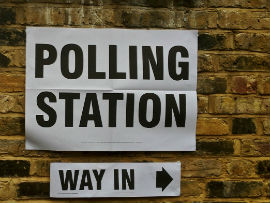
“This pattern is politically significant because UK elections and referendums are traditionally held on a Thursday—that’s exactly when anxieties loom largest.”
Previous research has found a strong link between risk aversion and the conservative right.
“Many commentators warned of the risks associated with leaving the EU. But the Leave campaign warned of the risks of staying,” Dr Jenkins added.
Jet Sanders said: “Perceived risk is more important than actual risk in shaping voter opinion. Someone who views the EU as a threat will be especially keen to leave it on a Thursday.”
“We know that the weekly cycle affects mood, and that mood affects decision making.It follows that the weekly cycle must affect decision making. This study is the first to show that directly.”
The new study, accepted for publication in the Journal PLOS ONE, tested this link by analysing opinion poll data from the Scottish Independence Referendum of 2014 and the United Kingdom European Union membership referendum of 2016.
“In both referendums, opinion shifted to the right on Thursday”, said Dr Jenkins. “In the Scottish Independence Referendum, asking the question on Thursday boosted the No campaign by around three per cent. In the EU referendum, it boosted the Leave campaign by about three per cent.”
Although the analysis focuses on two recent referendums, the researchers note that every UK general election since 1935 has been held on a Thursday. The findings suggest that the tradition of Thursday voting may consistently bias UK elections towards conservative outcomes.
Dr Jenkins added, “Polling data from a country that votes on a different day of the week would be interesting to compare. For example, American elections are traditionally held on Tuesday—a less risk-averse day than Thursday in our study.”
The researchers suggest that it may be possible to mitigate effects of weekday by allowing voting over several days, as with postal voting, or by distributing election days more evenly through the weekly cycle.
The human invention of the seven-day week has unintended consequences: the outcome of a decision can depend on the day on which it is taken, the authors conclude.
Further information
- The paper Weekly Fluctuations in Risk Tolerance and Voting Behaviour is published in PLOS ONE and can be found here: http://bit.ly/riskcycle. Tweet #riskcycle
- The work was funded by the Economic and Social Research Council Studentship (UK), and the Prins Bernhard Cultuurfonds (NL). The funders had no role in study design, data collection and analysis, decision to publish, or preparation of the manuscript.
- http://www.york.ac.uk/psychology/staff/


