English and Related Literature

- Department of English and Related Literature
- People
- Alexandra Kingston-Reese
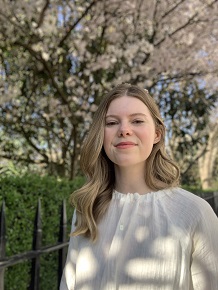
Alexandra Kingston-Reese
Visit Alexandra Kingston-Reese's profile on the York Research Database to:
- See a full list of publications
- Browse activities and projects
- Explore connections, collaborators, related work and more

Profile
Biography
Alexandra Kingston-Reese is a Senior Lecturer in Modern and Contemporary Literature. She specializes in 21st century literature and visual art, with a particular interest in the novel and essay after 1945, theory of the novel, the political essay, aesthetics, affect, and the medical humanities.
Alexandra joined the department in 2016. Before arriving at York, she completed her PhD, funded by the Australian Government, at the University of Sydney in December 2015. She grew up in Aotearoa/New Zealand.
Alexandra’s research focuses on the literature and visual culture of the late 20th and early 21st centuries, with a particular interest in the novel and essay after 1945, theories of the novel, the essay form, the history of aesthetics, theories of affect, and the intellectual histories pertaining to race, settler colonialism, queerness, and capitalism. She was the editor of ASAP/Review, one of the publications of the Association for the Study of the Arts of the Present, between 2020–2025. At York, Alexandra teaches modules on modern and contemporary literature, as well as on critical theory, at undergraduate and postgraduate levels. In 2021, Alexandra was awarded a Vice-Chancellor's Teaching Award for recognition of excellence in teaching, and her work has been regularly funded by the Centre for Modern Studies.
Research
Overview
Alexandra’s research interests span literature and visual culture of the late 20th and early 21st centuries, with a particular interest in the novel and essay after 1945, theories of the novel, the essay form, the history of aesthetics, theories of affect, and the intellectual histories pertaining to race, settler colonialism, queerness, and capitalism.
Alexandra’s first monograph, Contemporary Novelists and the Aesthetics of Twenty-First Century American Life (University of Iowa Press, 2019) asked how contemporary writers imagine aesthetic experience. Examining the works of some of the most popular names in contemporary fiction and art criticism, including Zadie Smith, Teju Cole, Siri Hustvedt, Ben Lerner, Rachel Kushner, and others, the monograph revealed how contemporary writers refract and problematize aesthetic experience, illuminating an uneasiness with failure: firstly, about the failure of aesthetic experiences to solve and save; and secondly, the literary inability to articulate the emotional dissonance caused by aesthetic experiences now. Ultimately, it argued that a genre of the novel that could be thought of as the contemporary art novel reconciles the negative feelings of contemporary life through a concerted critical realignment in understanding artistic sensibility, literary form, and the function of the aesthetic.
She is the editor of Art Essays (University of Iowa Press, 2021), a collection of the best essays on the visual arts written by contemporary novelists, including award-winning writers such as Zadie Smith, Chris Kraus, Teju Cole, Orhan Pamuk, and Jhumpa Lahiri. From the art of Sonia Delaunay to contemporary photography, from the docks of Malaysia to Leonora Carrington’s home in Mexico City, and from reflections on modern Black British paintings to meditations on the female gaze, this collection stakes a claim for what the form of the art essay makes possible.
Alexandra is currently at work on two interrelated projects on thinking. The first is her second monograph, Properties of Thought, which charts a new understanding of allegory’s dialectical thinking in the present moment. Through readings of Hegel, Marx, Adorno, and Jameson, alongside cultural forms ranging from the novels of Eleanor Catton and Paul Beatty, from the photography of Carrie Mae Weems and the painting of Ebecho Muslimova to the socially engaged art of Valeria Luiselli, and from Black aesthetics to autofiction, Properties of Thought shows how the embattled category of allegory slices open some of the contemporary moment’s most pervasive critical problems in theorising art’s relationship to the false immediacies of late capitalism.
The second is a collaborative project on essayism as a style of political thinking. Displaying an unique ability to move fluidly between political experience or the politically pregnant moment and the bigger picture, the essay emerges as a form ideally suited for performing political thinking through examination, free-association, and transformation.
Her essays and criticism have appeared and are forthcoming in publications including New Literary History, Mosaic, Modern Fiction Studies, Critique, Post45, Art History, The Australian Humanities Review, ASAP/Review, and ASAP Journal. Her public criticism has appeared in the Los Angeles Review of Books, Literary Hub, and the Times Literary Supplement. She is also co-editing a special issue of ASAP/Journal on 'Forms of Care' (2026). What forms care take is a question that has spurred scholarly and political debates that expose the histories of coerced care under colonialism and racial capitalism, lament the systematic dismantling of caring infrastructures under neoliberalism in the Global North, and at the same time call for a more expansive sense of caring activities and imaginaries. Given the urgency and purpose with which care and caregiving have become the focus on disciplinary conjunctions and collaborations, this volume aims to prompt a newly vital consideration of what care has been as an aesthetic field of study and where it might be heading.
Alexandra was the editor of ASAP/Review, one of the publications of the Association for the Study of the Arts of the Present, between 2020–2025.
Supervision
Enquiries from prospective research students interested in the connections between post45 American or comparative literature and intellectual history would be warmly welcome, particularly on topics related to form (the novel and the essay); theories of affect; Marxist thought and contemporary culture; aesthetics and moral philosophy; interdisciplinary projects on the visual arts and music.
Past and present projects include, among others, those on: self-care under Trump; the literature of suspicion; the affects of the Brexit literature; the aesthetics of contemporary serialism.
Teaching
Undergraduate
Alexandra teaches and lectures broadly across the department, but mostly on modern and contemporary literature and critical theory. Specialist modules include ‘Art in the Present’, and ‘21st Century American Literature’.
Postgraduate
At MA level, Alexandra runs the module ‘Bad Feelings’, on the affects of contemporary literature, and contributes to a range of MA modules, including ‘Framing the Contemporary’, ‘Reading Modernity’, ‘Queer Encounters’, and ‘Debating Global Literary Culture’.
In 2021, Alexandra was awarded a Vice-Chancellor's Teaching Award for recognition of excellence in teaching. She is the co-founder and co-organiser, with Dr Shazia Jagot and Dr Lola Boorman, of UoY English’s Decolonizing Network.